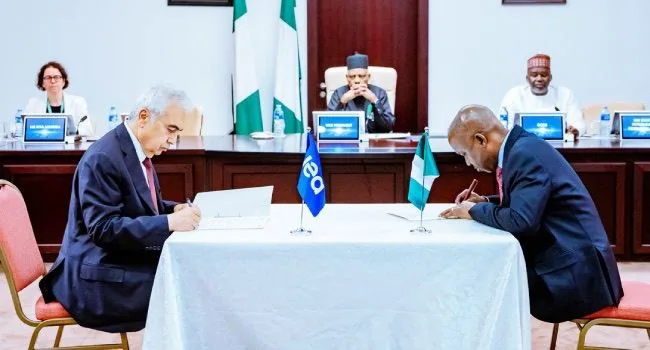
The agreement was signed in Abuja on Thursday, September 3, 2026, marking the formal beginning of a structured partnership between Nigeria and the Paris-based energy organisation.
Vice President Kashim Shettima, who represented President Bola Tinubu at the ceremony, described Nigeria’s admission as a major milestone and a reflection of the country’s growing importance in the global energy sector.
Shettima said the development also demonstrated the impact of the economic reforms introduced by the Tinubu administration, particularly efforts to maximise Nigeria’s vast energy resources.
He said the partnership would give Nigeria access to the IEA’s technical expertise, institutional knowledge, data and international network, which could support the country’s energy ambitions and strengthen energy security.
The Vice President also highlighted Nigeria’s significant renewable energy potential, stressing the administration’s determination to use the country’s available resources to drive economic development.
He assured the IEA of Nigeria’s willingness to contribute to international discussions on energy and support a fair and sustainable transition to cleaner energy.
Speaking on the partnership, IEA Executive Director, Fatih Birol, said the organisation works across a wide range of energy technologies, including oil and gas, solar power, nuclear energy, artificial intelligence and electric vehicles.
Birol explained that becoming an association country requires extensive consultations and assessments.
He said Nigeria’s admission was unanimously approved by the IEA Governing Board after discussions with Nigeria’s Minister of State for Petroleum Resources, Ekperikpe Ekpo, describing the decision as a sign of confidence in the country.
According to him, the IEA will work closely with Nigeria in the coming years by providing policy support in areas ranging from clean cooking and gas markets to technical training for
Nigerian energy professionals.
Meanwhile, the Minister of State for Petroleum Resources, Gas, Ekperikpe Ekpo, attributed Nigeria’s admission to the economic reforms implemented by the Tinubu administration.
He said the Joint Work Programme would facilitate greater technical cooperation between Nigerian institutions and IEA experts, particularly in generating reliable energy data needed for effective policymaking, investment and long-term energy security.
The Minister of State for Foreign Affairs, Sola Enikanoaiye, described the partnership as strategically important to Nigeria, acknowledging the role played by the Nigerian Mission in Paris in advancing the process.
Also speaking, the Director-General of the Energy Commission of Nigeria, Mustapha Abdullahi, said the commission had previously collaborated with the IEA, including through the joint sponsorship of Nigeria’s National Energy Master Plan.
Abdullahi noted, however, that the relationship had operated without a formal framework.
He expressed optimism that Nigeria’s new status and the Joint Work Programme would provide a stronger foundation for sustained cooperation and deepen technical collaboration between the two institutions.