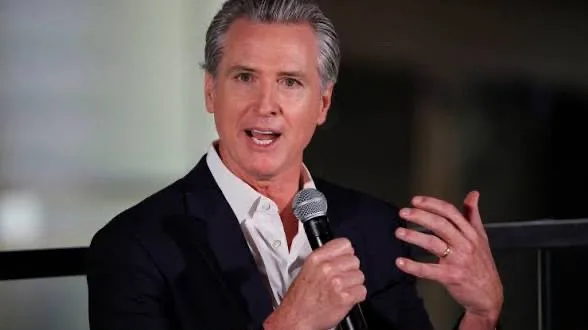
California Governor Gavin Newsom has approved the commutation of death sentences imposed on all 548 inmates awaiting execution in the state, in what is being described as the largest mass clemency exercise in United States history.
The decision, announced on Thursday, effectively brings an end to death sentences in California, although the state has not carried out an execution in two decades. Under the new arrangement, the affected inmates will serve life imprisonment without the possibility of parole.
Newsom said the decision was informed by his opposition to capital punishment, arguing that executions carried out by the state conflict with California's principles and weaken public confidence in the justice system.
In an open letter announcing the move, the governor said he believed state-sanctioned executions were incompatible with the state's values and undermined the foundations of its legal system.
The development comes amid a gradual decline in public support for capital punishment across the United States, although a majority of Americans still favour its use for people convicted of murder.
A Pew Research Center survey released in August found that 66 per cent of Americans supported the death penalty for murder convictions. However, about 73 per cent expressed concern that an innocent person could be wrongly executed.
Legal challenges and lengthy appeals have also contributed to the declining number of executions, with many inmates spending decades on death row before their cases are resolved.
At least 23 US states have abolished capital punishment, while several others have stopped carrying out executions despite retaining the penalty in their laws.
However, President Donald Trump has continued to advocate for its use, particularly for serious federal offences. In April, his administration announced plans to expand federal executions, including the possible use of firing squads.
Supporters of capital punishment maintain that it serves as a deterrent against serious crimes, but opponents argue that research has failed to establish that executions significantly reduce criminal activities.
Critics have also raised concerns about the financial burden of death penalty cases, the possibility of wrongful convictions, racial disparities and botched executions.
Figures from the Death Penalty Information Center (DPIC) indicate that California has spent approximately $6bn on capital punishment since 1978, despite carrying out only 13 executions during the period.
The organisation also reported that at least 203 people sentenced to death in the United States since 1973 were subsequently exonerated after being wrongly convicted.
Newsom's announcement has attracted commendation from criminal justice advocacy groups, which described the decision as a significant development in efforts to end capital punishment.
Executive Director of the DPIC, Robin Maher, said the governor's action represented an important turning point in the history of the death penalty in the country.
She noted that although other governors had previously granted broad clemency, none had taken action on a scale comparable to California's latest decision.
Maher added that Newsom had significantly altered the state's position on capital punishment, having first imposed a moratorium on executions and now approved the mass commutation.
However, the DPIC explained that approximately two-thirds of the commutations would require review by the California Supreme Court before becoming final, as state law mandates judicial scrutiny of clemency granted to individuals with multiple felony convictions.
Despite its reputation as a liberal state, California previously played a major role in promoting tougher criminal justice policies during the 1990s, when the United States adopted stricter approaches to crime.
California and Washington were among the earliest states to introduce 'three strikes' laws, which prescribed lengthy minimum prison terms for repeat offenders.
The state currently has the largest death row population in the United States. Newsom's decision is expected to reduce the country's total death row population by almost 30 per cent.
The announcement also comes shortly after the Democratic Party recorded significant victories in the US midterm elections, making gains in traditionally Republican strongholds, including Texas and Kansas.
The electoral gains have fuelled speculation about possible Democratic contenders for the 2028 presidential election, with Newsom frequently mentioned as a potential candidate.
Having served nearly eight years as governor, Newsom is approaching the end of his constitutionally permitted tenure. His second and final term is expected to end in January 2027, when former US Secretary of Health and Human Services Xavier Becerra is scheduled to succeed him on January 4.
Newsom has increasingly taken an active role in supporting Democratic candidates across the country, further strengthening speculation about his possible presidential ambitions.
Nevertheless, his record on criminal justice reforms has drawn criticism from some advocacy organisations and lawmakers.
In 2022, he rejected a proposed bill seeking to restrict the use of solitary confinement in state prisons, a practice the United Nations has described as torture under certain conditions and durations.
He had also vetoed legislation in 2019 that sought to limit cooperation between Immigration and Customs Enforcement (ICE) and prison authorities. A similar proposal failed to advance in the state Senate in 2022.