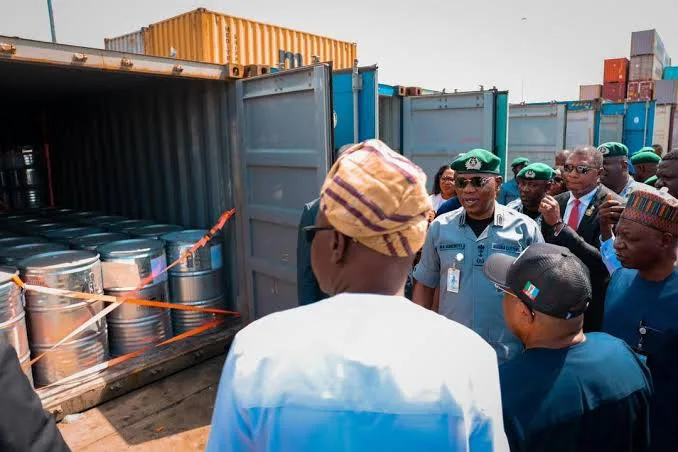
The Nigeria Customs Service (NCS) has begun clearing 98 containers of electricity transmission equipment held at the Apapa and Tin-Can Island ports in Lagos following the approval of waivers on accumulated charges.
The Comptroller-General of Customs, Adewale Adeniyi, announced this on Friday during the official flag-off of the evacuation exercise in Lagos.
Adeniyi said the Minister of Finance, Taiwo Oyedele, approved the waivers to enable the release of the consignments, some of which had remained at the ports for between 14 and 20 years.
He explained that 44 containers were being evacuated from the ENL terminal, while the remaining 54, located at APMT and Sun & Moon terminals, would also be released.
The consignments include high-capacity transformers, power cables, switchgear and other critical transmission materials imported for the Federal Ministry of Power and government-owned agencies, including the Transmission Company of Nigeria (TCN) and Niger Delta Power Holding Company (NDPHC).
According to Adeniyi, the exercise follows a presidential directive aimed at ensuring the immediate clearance of more than 200 containers of electricity-related equipment.
He said the Customs Service had introduced special clearance arrangements, including priority processing, dedicated officers for joint inspections and the implementation of approved waivers to ensure the swift evacuation of the consignments.
The Customs chief added that the service was collaborating with the Federal Ministry of Power, TCN, NDPHC, Nigerian Ports Authority and other maritime stakeholders to facilitate the process.
He further disclosed that technical experts would examine the equipment after evacuation to determine their condition and identify those suitable for immediate use in ongoing and abandoned electricity projects.
Adeniyi said serviceable equipment would be deployed to transmission lines and substations across the country, while obsolete materials would be disposed of based on professional recommendations.
Speaking at the event, the Minister of Power, Joseph Tegbe, said the equipment was originally purchased to strengthen Nigeria's electricity transmission infrastructure, expand network capacity and reduce pressure on existing substations.
He noted that the prolonged delay in clearing the materials had prevented their deployment, leaving existing facilities to bear electricity loads that were supposed to be distributed across newly planned infrastructure.
Tegbe said the situation had affected the efficiency and flexibility of the national electricity network, stressing the need to recover and utilise the equipment.
He explained that engineers would conduct a comprehensive inventory, inspect the materials and carry out necessary technical assessments and tests to establish their usability.
The minister added that equipment requiring repairs or other interventions would be serviced before being deployed to designated locations.
He disclosed that some of the materials were still in relatively good condition and would be distributed to project sites in Kaduna, Lafia, Kwale and other parts of the country.
According to him, the deployment would help restore available capacity, strengthen transmission infrastructure and improve operational efficiency within the power sector.
The evacuation exercise comes amid efforts by the Federal Government to address persistent electricity supply challenges.
It also follows a directive by the Minister of Power to the Transmission Company of Nigeria, Nigerian Independent System Operator (NISO) and electricity distribution companies to resolve operational issues contributing to the recent decline in power generation, as households and businesses continue to experience widespread outages and load shedding.