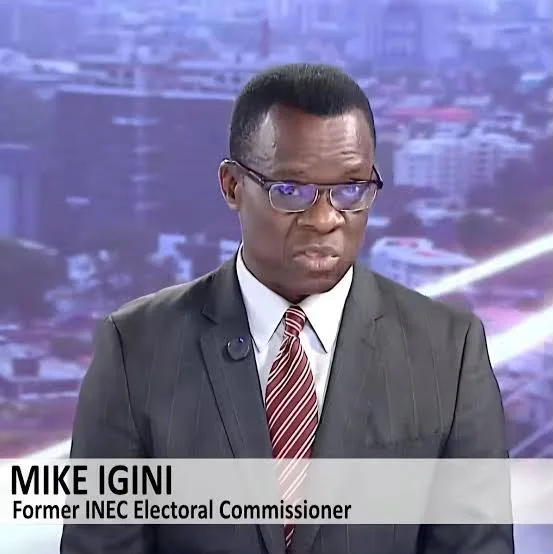
Former Independent National Electoral Commission (INEC) Resident Electoral Commissioner, Mike Igini, has warned that weaknesses in Nigeria’s electoral process create opportunities for the manipulation of election results, particularly at polling units and during collation.
He disclosed this during an interview with SYMFONI, where he recounted an experience in Imo State in which politicians attempted to swap election results after voting had been concluded.
Igini, who served as REC in Cross River State, said an Electoral Officer on an election intervention assignment with him alerted him that politicians had approached her with plans to alter the results already recorded.
According to him, the officer, with the support of a security operative, informed him that the planned operation would take place later that day.
He said he immediately contacted his security team and arranged for the officer to be moved to the INEC office in Owerri before the planned manipulation could take place.
Igini explained that the experience reinforced the need for a transparent electoral system that would prevent results from being altered between polling units and collation centres.
He said the introduction of electronic transmission of results was intended to address such loopholes by making polling-unit results accessible to the public.
The former commissioner explained that the system was further developed to allow the uploading of images of Form EC8A, the polling-unit result sheet, alongside the recorded figures.
He noted that this would make it difficult for anyone to manipulate results during collation, particularly in situations where a candidate who won at the polling unit could eventually be declared to have lost.
“It is not enough to have results from the ward level. What about if they have manipulated it at the polling unit level?” he asked.
Igini also criticised the Supreme Court's interpretation of Section 60(5) of the Electoral Act 2002, arguing that the interpretation weakened the mandatory requirement for presiding officers to transmit election results.
He maintained that the provision was originally intended to strengthen transparency and ensure that results recorded at polling units were transmitted in accordance with INEC's regulations and guidelines.
On the role of the judiciary in Nigeria's democracy, Igini warned that failure to hold political actors accountable under the law could undermine democratic institutions.
“You see, a democracy without the rule of law has in it a virus that may lead to a death,” he said.
“The first early sign of the subversion of democracy is the failure of the courts to hold political actors accountable under the law,” he added.
The former REC also defended the right of journalists to publish election results officially announced at polling units.
He explained that the announcement of results at polling units was the responsibility of presiding officers, while the declaration and return of winners remained the exclusive responsibility of INEC.
According to him, journalists and party agents present at polling units are entitled to obtain copies of result sheets and report the figures, provided they reflect the results officially announced by the presiding officer.
He further cited Section 124 of the Electoral Act, which criminalises the publication of false election results, insisting that the law does not prohibit journalists from reporting authentic results announced at polling units.
“The true results, correct results, the journalist is free to say to the whole world,” he said.
Igini stressed that electoral transparency must begin at the polling-unit level, arguing that the credibility of elections depends on ensuring that votes cast by Nigerians are accurately recorded and reflected in the final results.