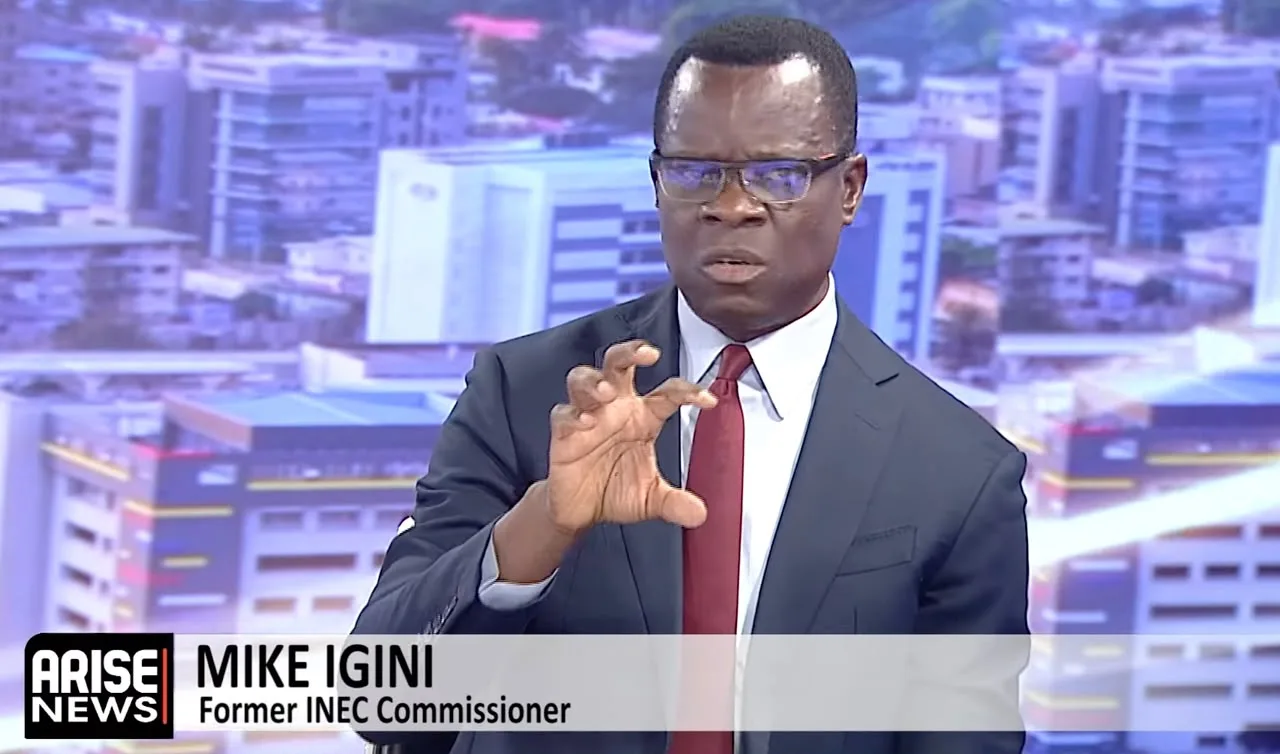
Former Independent National Electoral Commission (INEC) Commissioner Mike Igini has raised concerns over alleged political interference in the recruitment of election personnel, warning that the development could undermine the credibility of the 2027 general elections.
Igini, who spoke during an interview with ARISE NEWS on Tuesday, identified the alleged infiltration of agencies responsible for providing ad hoc election workers and the failure to enforce electoral laws as major threats to the electoral process.
He warned that political influence over the recruitment process could expose INEC to liabilities arising from the actions of other institutions.
“What happened is that politicians infiltrate those agencies. They infiltrate those agencies and create liability for the INEC itself as an institution. The laws are no longer enforced. That is my greatest worry about this election,” he said.
The former commissioner stressed that INEC must pay particular attention to the integrity of presiding officers, describing them as critical to ensuring that votes are properly cast, recorded and protected at polling units.
According to him, the credibility of elections depends significantly on the officials entrusted with managing the process at the grassroots level.
“The most important staff that Nigeria should focus on will be the presiding officers,” Igini said.
He also questioned the government's ability to ensure accountability in the electoral system, arguing that public resources spent on election administration must translate into credible outcomes and responsible conduct by officials.
“The state has failed to protect the vote of Nigerian people. How can you pay 26.7 billion? Yet those people cannot be held accountable?” he asked.
Igini linked Nigeria's electoral challenges to broader problems of leadership recruitment and governance, insisting that efforts to improve the economy would remain ineffective without reforms to the political system.
“The crisis of Nigeria is a leadership recruitment process,” he said, adding, “If we cannot fix the politics, we cannot fix our economy.”
He further expressed concern that the country's commitment to the rule of law was being weakened by the growing influence of individuals, warning against a system in which personal interests supersede established laws.
“And that today, where we are supposed to be under the rule of law, we are now under the rule of men,” he said.
On electoral transparency, Igini maintained that openness was essential to building public trust and rejected secrecy as an appropriate response to demands for greater accountability.
“The call for openness and transparency can never be answered by secrecy,” he stated.
He also dismissed arguments against political parties and candidates publicly announcing their own election results, describing such objections as fundamentally flawed.
“The argument that candidate political party cannot publicise their result is wholly incorrect,” he said.
Igini emphasised that polling units remained the foundation of the electoral process, warning that weaknesses in the system could create opportunities for unauthorised individuals to announce results.
“And so, at the heart of this election is the polling unit. That's the key,” he said.
Reflecting on irregularities associated with the 2023 general elections, he warned that concerns over unauthorised result announcements had yet to be adequately addressed.
“So somebody can come and impersonate tomorrow and just announce electoral results. This story happened in 2023. We've not sorted it out till date,” he said.
The former INEC commissioner also underscored the importance of technology in strengthening electoral administration, warning that institutions that fail to embrace technological advancements risk falling into inefficiency and decline.
“Any organisation that failed to embrace the benefit of technology will be overtaken by the chaos or decay and decline,” he said.
Igini further condemned alleged attempts to intimidate journalists and citizens reporting on electoral matters, citing Section 39 of the Nigerian Constitution, which guarantees freedom of expression and the press.
“The attempt to intimidate media, houses, intimidate Niger citizens, that they cannot report, is a violation of section 39,” he said.
He called for greater accountability among public officials, arguing that those entrusted with public responsibilities must face consequences for misconduct.
“What I said that we need to build more prisons because many of the characters you see today in public offices, they are simply candidates for prison,” he added.
Igini urged stakeholders to safeguard the electoral process ahead of the 2027 polls, noting that credible elections remain essential to democracy and the peaceful transfer of political power.
“We have to be very careful, because the greatest promise of democracy is periodic election for peaceful transfer of power,” he said.