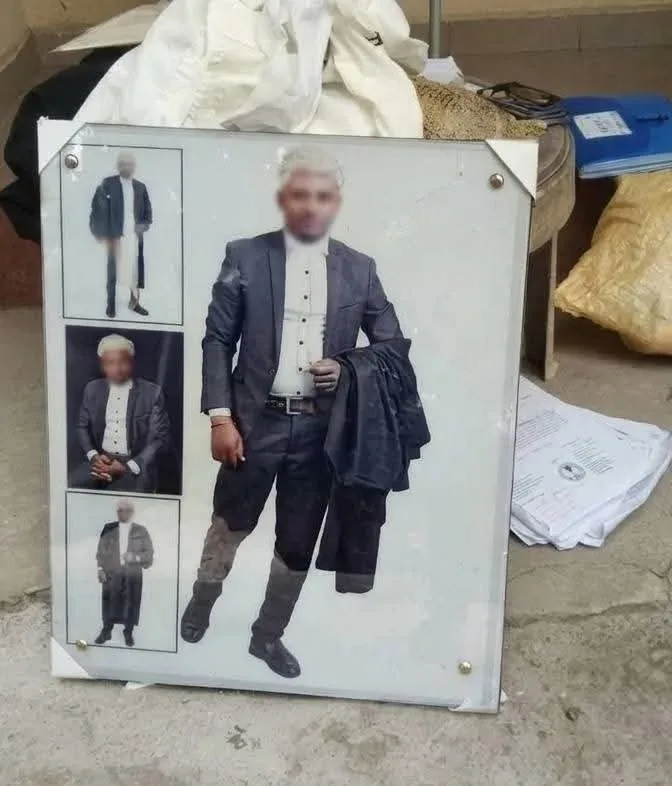

The Federal Capital Territory High Court in Abuja has sentenced a staff member of the Federal Capital Development Authority (FCDA), Kinsley Eselebor, to 25 years in prison for defrauding a land buyer through false representations and forged documents.
Justice A.O. Musa delivered the judgment on Wednesday, October 28, 2026, after finding Eselebor guilty on all five counts filed against him by the Economic and Financial Crimes Commission (EFCC).
The court imposed seven years’ imprisonment each on counts one, two and three, and two years each on counts four and five. The sentences are to run concurrently, with no option of a fine.
The prosecution established that Eselebor, who worked in the FCDA’s Department of Urban and Regional Planning, collected money from Moses Osinachi for the purchase of two plots of land at Kubwa District Central Annex, Abuja, without possessing a valid title to transfer ownership.
The properties, identified as Plots 383 and 424, were presented to Osinachi as genuine plots available for sale.
The case was initially filed in March 2021 with three counts of obtaining money under false pretences. The charges were subsequently amended to five, with the additional counts bordering on the use of forged documents as genuine.
Court proceedings revealed that Osinachi and Eselebor were neighbours and attended the same church. Their relationship, alongside Eselebor’s employment with the FCDA, reportedly strengthened the buyer’s confidence in the transaction.
Evidence presented before the court showed that Eselebor used two conveyance documents bearing the names Yusuf Lawan and Adegoke Asiwaju to convince Osinachi that the properties were genuine.
When Osinachi sought confirmation of the documents, Eselebor assured him of their authenticity, citing his position within the FCDA.
Relying on the assurances, Osinachi transferred funds from his company, Moscow International Services Limited, to Eselebor for the purchase of the two plots.
The transaction later ran into difficulty when Osinachi attempted to take possession of the properties and discovered that Eselebor had no valid title to transfer to him.
When confronted, Eselebor reportedly acknowledged that the properties had competing claims and promised to provide alternative plots. However, he failed to fulfil the promise.
Osinachi subsequently demanded a refund, but the matter remained unresolved as Eselebor’s explanations reportedly changed over time.
The aggrieved buyer later petitioned the EFCC, which investigated the matter and prosecuted Eselebor.
Reacting to the judgment, the EFCC’s Director of Criminal Litigation and prosecution counsel, Joshua Saidi, said the conviction should serve as a warning to individuals involved in land racketeering and the use of forged documents to defraud unsuspecting buyers.
Saidi expressed concern that Eselebor’s position as an FCDA employee had helped establish trust in the transaction, despite the use of fraudulent documents.
He said the judgment reinforced the need to hold individuals accountable when they exploit public positions and the confidence of others for personal gain.
The conviction highlights the dangers of fraudulent property transactions in Abuja, particularly where buyers rely on official connections and documents presented by individuals claiming to have links to land administration authorities.