
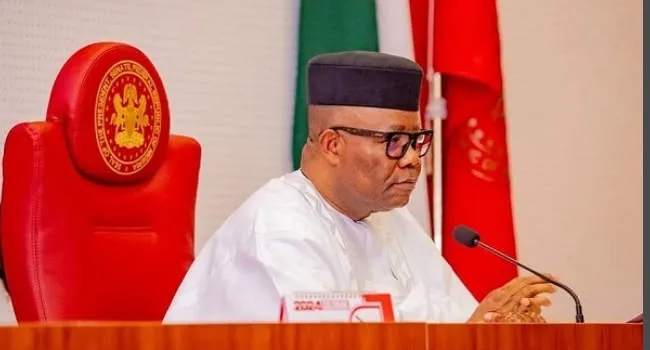
The Nigerian Senate has unanimously affirmed that there is no vacancy in the office of the Senate President, reaffirming Senator Godswill Akpabio’s position amid political speculation and controversy over his recent comments on a proposed law to decriminalise attempted suicide.
The resolution followed deliberations during Thursday’s plenary, where Akpabio addressed public reactions to his remarks on the bill, which passed second reading on Tuesday.
The Senate President said his comments had been taken out of context, warning television commentators and other public analysts against misrepresenting proceedings of the upper legislative chamber.
Akpabio also maintained that terrorism should not be associated with any religion, insisting that those responsible for destabilising Nigeria should not be identified with the country.
Defending his position on religious matters, he explained that his long-serving Aide-de-Camp (ADC) was a Muslim and said he would not make derogatory remarks against any faith.
He further argued that suicide was prohibited under Christianity, while discussions on the proposed legislation reflected the need to review existing laws in line with contemporary legislative practices.
Akpabio also cautioned against the belief that killing others in the name of suicide could guarantee entry into heaven or paradise.
Amid the heated exchange, the Senate President suggested that political interests were increasingly targeting his office, noting that the positions of President and Vice-President had already been settled.
Supporting the resolution, Senator Fasuyi backed a motion moved by Senator Monguno, affirming that the Senate Presidency was not vacant and would remain occupied by Akpabio.
Similarly, Senator Babangida Hussaini expressed support for Akpabio’s continued leadership, highlighting his contributions to his state.
Hussaini also called for stronger action against drug abuse and the circulation of hard substances, warning that the problem must be addressed as part of efforts to tackle banditry, terrorism and other criminal activities across the country.
The controversy surrounding Akpabio’s comments arose during Tuesday’s debate on a bill seeking to remove criminal penalties for attempted suicide and establish a coordinated framework for suicide prevention.
During the presentation of the proposed legislation, Senator Asuquo explained that the bill was designed to replace prosecution and imprisonment for suicide attempt survivors with medical assessment, treatment, referral and continued support.
He argued that the proposed law went beyond removing criminal sanctions by establishing a framework for government agencies, healthcare providers, first responders and communities to identify risks and respond effectively to people experiencing suicidal crises.
Asuquo maintained that individuals who survived suicide attempts should receive appropriate medical and psychological care rather than face prosecution.
He also warned that criminalising attempted suicide could discourage people from seeking help and potentially push those experiencing suicidal thoughts to make more determined attempts to end their lives out of fear of imprisonment if they survived.
In response, Akpabio questioned whether the proposed legislation was intended to prevent people from succeeding in suicide attempts.
Asuquo answered in the affirmative, explaining that the central concern was the threat of imprisonment for those who survived.
Akpabio, however, maintained that attempted suicide remained a criminal offence under the existing legal framework, making comments that drew widespread attention and criticism.
The exchange has brought renewed focus to the bill’s central objective of shifting Nigeria’s response to attempted suicide from punishment to prevention, treatment and rehabilitation.
If enacted, the proposed legislation would provide a legal basis for coordinated suicide prevention services, including crisis helplines, referral systems and follow-up care for survivors.
The proposal is intended to ensure that people experiencing suicidal crises can access timely medical and psychological support rather than face criminal prosecution.